
Lovebirds (Agapornis species) are captivating, social parrots that often form deep bonds with their human caregivers. However, determining whether your lovebird is male or female can be surprisingly challenging—especially since many species are monomorphic, meaning both sexes look alike.
In this guide, we’ll walk you through reliable methods to determine the sex of your lovebird, from behavioral clues to DNA testing—backed by expert insight and avian veterinary guidance.
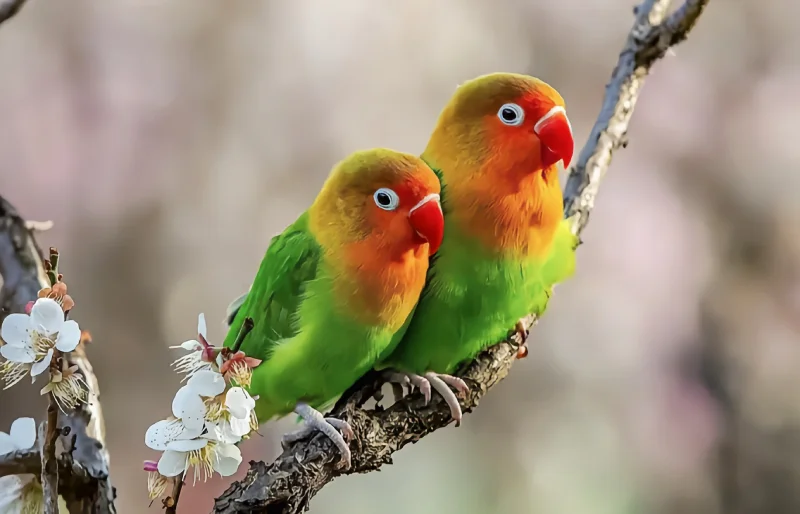

1. Why It’s Difficult to Sex a Lovebird
Unlike some parrot species, lovebirds do not exhibit clear physical differences between males and females in most cases. This makes visual sexing highly unreliable without prior experience.
Expert Insight:
“In the case of Peach-faced, Masked, and Fischer’s lovebirds, males and females are nearly identical in size and color, making sexing by sight alone very difficult.”
— Dr. Katherine Morales, Avian Veterinarian, AAV Member
2. Methods for Determining a Lovebird’s Sex
A. DNA Sexing (Most Reliable)
- Method: A small blood or feather sample is sent to a specialized avian DNA lab.
- Accuracy: 99%+
- Cost: $20–$40 USD (depending on the service)
- Best For: Pet owners, breeders, and anyone seeking certainty.
Recommended Labs:
B. Surgical Sexing (Used in Breeding Programs)
- Method: A vet performs a minor endoscopic procedure under anesthesia to inspect internal organs.
- Risk: Minimal but invasive; not recommended for pet owners unless medically necessary.
- Accuracy: 100%
- Use Case: Primarily used in professional aviaries and breeding programs.
C. Physical Indicators (Less Reliable)
While visual inspection is often inaccurate, some breeders use the following clues with limited success:
| Feature | Female | Male |
|---|---|---|
| Pelvic bones | Wider apart (2+ finger width) | Closer together (1 finger width) |
| Body shape | Broader, stockier | Slender, more streamlined |
| Sitting posture | Flatter, more sprawled | Upright and narrow |
Note: These traits are not always reliable and vary among individuals.
D. Behavioral Traits (Suggestive, Not Conclusive)
Behavioral differences can offer clues, especially in bonded pairs:
| Behavior | Likely Female | Likely Male |
|---|---|---|
| Nesting behavior | Shreds paper, hides in nesting areas | Rarely nests, more territorial |
| Aggression | More protective of nest box | More vocal and dominant |
| Mating behavior | May lift tail, accept mounting | May attempt to mount |
Expert Tip:
“Behavioral sexing is useful over time, especially when observing pairs—but should not replace DNA testing for accuracy.”
— Lisa Chang, Certified Avian Behavior Consultant
3. Can You Tell Gender Based on Color?
Only two lovebird species are sexually dimorphic:
Madagascar Lovebird (Agapornis canus)
- Males: Bright green
- Females: Duller grayish-green
Abyssinian (Black-winged) Lovebird (Agapornis taranta)
- Males: Bright red forehead
- Females: Entirely green
All other species—including the popular Peach-faced, Masked, and Fischer’s Lovebirds—look identical across sexes.
4. Why Knowing the Sex Matters
For Pet Owners:
- Prevents accidental breeding in mixed pairs
- Helps identify hormonal behaviors (e.g., egg-laying, aggression)
- Improves targeted health monitoring
For Breeders:
- Essential for pairing purposes
- Required for avian health certifications and registry
- Informs gene pool diversity
5. Trustworthy Resources for Further Reading
- Association of Avian Veterinarians (AAV) – aav.org
- Avian Genetics and DNA Sexing Guide – Avian Biotech, 2024
- The Lovebird Handbook by Nikki Moustaki (2nd Edition)
- Cornell Lab of Ornithology – Lovebird Behavior
Conclusion
While physical and behavioral clues can offer hints, the most accurate way to determine a lovebird’s sex is through DNA testing. Understanding your lovebird’s gender helps improve care, manage behavior, and prevent unintended breeding.
If you’re uncertain or notice signs like egg-laying or aggressive nesting, consult with an avian-certified veterinarian for guidance.
Article title: How to Know if a Lovebird Is Male or Female
Article link: https://www.parrot234.com/how-to-know-if-a-lovebird-is-male-or-female/
Disclaimer: The content of this site is contributed by users, compiled from the Internet, or edited by AI, so no guarantee can be made for the authenticity of the content! Please judge the authenticity of the content by yourself! However, if you find any suspected: plagiarism, infringement, illegal and irregular, suspected fraud, false and bad content, please contact this site in time through the "Contact & Suggestion" channel at the bottom. This site always maintains an active and cooperative attitude to deal with various problems, so after receiving the email, the corresponding content will be deleted!
