
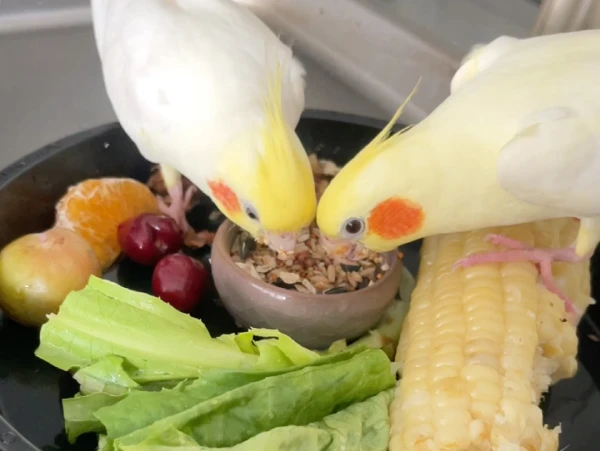

What is Cockatiel Intelligence?
Cockatiel intelligence refers to their capacity for learning, problem-solving, memory, and social understanding. It’s not about measuring against human or parrot standards but appreciating their unique cognitive adaptations as members of the cockatoo family.
- Key Distinction from Similar Concepts: It’s often confused with simple trick training. While training demonstrates learning ability, true bird intelligence encompasses spontaneous problem-solving (like figuring out a cage latch) and complex social learning (observing and imitating flock mates).
- Key Components:
- Tool Use & Problem-Solving: Demonstrated in experiments where they manipulate objects to achieve a goal.
- Vocal & Sound Learning: Ability to mimic whistles, sounds, and sometimes speech, indicating advanced auditory processing.
- Social Cognition: Understanding social cues, recognizing individual humans/flock members, and engaging in coordinated behaviors.
Why Understanding Their Intelligence Matters
Ignoring your cockatiel’s cognitive needs is akin to keeping a lively mind in a dull room. Science underscores the necessity of engagement.
- The Data: A landmark 2015 study from the University of Vienna highlighted that cockatoos (the family including cockatiels) exhibit remarkable flexibility in problem-solving and tool use, rivaling some primates. While specific cockatiel studies are fewer, their status as cockatoos strongly suggests similar, if scaled-down, cognitive prowess.
- Negative Consequences of an Unstimulating Environment:
- Behavioral Problems: Boredom is a primary cause of feather plucking, incessant screaming, and aggression.
- Poor Welfare: Lack of mental challenge leads to stress, anxiety, and a reduced quality of life.
- Weakened Bond: A bird with an unchallenged mind is less engaged, making positive, trusting interactions harder to build.
Enriching Their Minds
Think of these as frameworks to systematically engage your bird’s learning ability.
1. Positive Reinforcement Training
This is the gold standard for teaching behaviors and building communication. It works by rewarding desired actions.
- Execution Steps:
- Choose a Reward: Find a high-value treat (e.g., a piece of millet).
- Mark the Moment: Use a clicker or a distinct word like “Good!” the instant your bird performs the desired action (e.g., stepping onto your finger).
- Immediate Reward: Follow the mark immediately with the treat.
- Repeat & Build: Practice in short, frequent sessions (5-10 minutes).
- Example Training Goals & Methods: Goal BehaviorInitial Step to RewardProgressionStep-UpBird touches target stick with its beak.Gradually move stick so bird must step onto it.Recall/Flying to YouBird turns its head towards you when called.Reward short hops, then longer flights.Playing with a New ToyBird looks at or approaches the toy.Reward any interaction (touch, peck) with the toy.
2. Environmental Enrichment
This strategy focuses on making their living space dynamic and challenging.
- Execution Steps:
- Foraging: Hide food in paper cups, foraging boxes, or rolled-up paper instead of using an open bowl for all meals.
- Toy Rotation: Maintain a collection of toys (destructible, shreddable, puzzle types) and swap 2-3 in/out weekly to maintain novelty.
- Novelty Introduction: Regularly introduce safe, new items to explore—different perches (natural wood, rope), untreated wood blocks, or stainless steel chains with links.
Recommended Workflow for Mental Engagement
Adopt a phased approach to integrate these strategies sustainably.
- Assessment (Week 1): Observe your cockatiel. What does it already play with? What sounds does it make? What is its favorite treat? Establish a baseline.
- Goal Setting & Prep (Week 2): Choose one primary goal (e.g., target training) and one enrichment focus (e.g., foraging). Gather necessary tools (target stick, foraging toys).
- Implementation & Consistency (Ongoing): Begin 5-minute daily training sessions. Implement the new enrichment (e.g., put 30% of daily food in a foraging toy).
- Review & Iterate (Monthly): Is the bird engaged? Is a behavior mastered? Adjust difficulty, introduce new toys, or set a new training goal.
Your Cockatiel Intelligence Questions Answered
Q: My cockatiel doesn’t talk. Does that mean it’s not intelligent?
A: Absolutely not. Vocal mimicry is just one facet of intelligence. A silent bird may be an exceptional problem-solver, observer, or social manipulator. Focus on the skills it doesshow, like figuring out how to get a favorite toy.
Q: How smart are they compared to a dog or a cat?
A: It’s a different type of intelligence. While dogs excel in social cooperation with humans, and cats are solo hunters, cockatiels show advanced avian cognition in areas like tool use and complex social learning within flocks. They are more comparable to intelligent toddlers in their curiosity and need for varied stimulation.
Q: Why does my bird learn some things (a whistle) instantly but ignores training for a week?
A: Motivation and context are key. The whistle may have had high social or intrinsic reward value. For training, ensure you’re using the highestvalue treat in a quiet, low-distraction environment. Their attention span is short, so keep sessions brief and positive.
Q: My cockatiel seems fearful of new puzzles. How do I encourage it?
A: Go slower. Place the new puzzle nearthe cage for a few days. Then, place a favorite treat right next to it inside the cage. Reward any glance or approach toward it. Never force interaction. Building confidence is part of cognitive growth.
Conclusion
Your cockatiel’s mind is a vibrant landscape ready for exploration. The science is clear: these are cognitively complex creatures deserving of an engaging life. Start small—introduce a single foraging challenge or initiate a two-minute target training session today. Observe, reward, and be patient. By actively nurturing their learning ability, you’re not just preventing problems; you’re unlocking a deeper, more fulfilling partnership with your feathered friend.
This guide is based on established principles of avian cognitive ethology and positive reinforcement animal training. For further reading on parrot intelligence, consult resources from authoritative institutions like the Association of Avian Veterinarians (AAV)or research publications from universities with animal behavior programs.
Article title: Cockatiel Intelligence: What Science Says About Their Learning Ability
Article link: https://www.parrot234.com/cockatiel-intelligence-what-science-says-about-their-learning-ability/
Disclaimer: The content of this site is contributed by users, compiled from the Internet, or edited by AI, so no guarantee can be made for the authenticity of the content! Please judge the authenticity of the content by yourself! However, if you find any suspected: plagiarism, infringement, illegal and irregular, suspected fraud, false and bad content, please contact this site in time through the "Contact & Suggestion" channel at the bottom. This site always maintains an active and cooperative attitude to deal with various problems, so after receiving the email, the corresponding content will be deleted!
